
Open letter to Andy Burnham

Recent events have amply demonstrated that the man in Whitehall does not know best.

The Rt Hon Andy Burnham PC MP
10 Downing Street
London SW1
Dear Prime Minister,
As you keep communicating with me through social media, I hope you don’t mind if I give you some feedback.
Now that you have your feet under the table, you will no doubt be using the summer recess to formulate strategy, undistracted by the clutter of parliamentary business.
I hope you will use the opportunity to get out into the British countryside to see for yourself rather than relying on what you are briefed by civil servants and special advisers. Last year, the Starmer family took a holiday cottage on an estate in Dumfriesshire (not mine!) and your predecessor was able to do the farm tour with the landowner and hear about the issues one-to-one. Needless to say, things were not as he had been led to believe by his officials. Not that it did us much good!
Your recent social media posts were no doubt crafted by one of your spin-doctors under your direction – you are a busy man and can’t be expected to draft everything yourself – and they have succeeded in giving the impression that you care about farming and want to change things for the better. But we will need more than warm words to butter the parsnips.

You say that you “have work to do to win the trust of the farming community.” That’s an understatement. There’s already lost ground to make up. Angela Eagle? What were you thinking? Still, at least it wasn’t the other Angela.
Labour governments are not naturally aligned with the farming community, we all get that. But that hasn’t stopped them producing some outstanding farming ministers in the past. And that’s the point, governments rarely win trust; individual secretaries of state do. And what trust governments do win is through ministers who understand their respective disciplines.
It would pay dividends for you to study the Attlee government. History judges it to have been a success, particularly in agriculture. This was largely down to the appointment of Tom Williams, who successfully shaped post-war farming policy.
I can recommend a book that was kindly sent to me by a Scribehound reader recently: Scattering Plenty, The People Who Made the Modern Countryside by Jim Dixon (The History Press). It discusses the achievements of Williams and others.

You have a potential Williams in your ranks. Daniel Zeichner spent years in opposition learning and gaining the trust of the countryside as shadow farming minister. Few people have a bad word to say about him. Yet you have appointed ministers to DEFRA with zero understanding of the countryside.
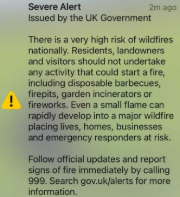
This year’s wildfires have amply demonstrated that the man in Whitehall does not know best. The nuclear alert we all received on our mobile phones following your COBRA meeting produced hollow laughs across the countryside. Not only were we being told to shut the stable doors after most of the horses had bolted, but many of us had been warning for years that the build-up of vegetation ‘fuel-load’ in the uplands was a disaster waiting to happen. Experience based on empirical evidence has been ignored and followed instead by woke ecology based on ideology.
As an aside, this ideology is also driving the so-called biodiversity crisis. Several red-listed ground nesting bird species are on the brink of extirpation because government has refused to acknowledge the worsening predator imbalance and the damage being done by unsustainably high populations of meso-predators such as badgers. Sooner or later, this is going to have to be confronted.
But back to wildfires. It is no coincidence that the vast majority were on land managed by the National Trust, the RSPB or other NGOs rather than by private landowners.
Environmentalism is clearly failing. Stopping or sharply reducing grazing and giving up on controlled burning meant that when fires started – and they always will – there was little chance of putting them out quickly. It has led to thousands of acres of some of the most important habitat for wildlife in the country being destroyed. It was a miracle that no one was killed. The thick vegetation wasn’t even much good for wildlife, which prefers a mosaic of different habitats, some of them almost bare, in which to breed and feed.
Your government needs to stop listening to Davos types, celebrity activists, zillionaire re-wilders and QANGO fat-cats and start listening to landowners, farmers, gamekeepers and other practical conservationists.
Rural communities proved their resilience during the fires. The Big State did not. If it had been left to the public sector many of those fires would still be burning. As it was, people who knew what they were doing (gamekeepers, farmers and digger drivers) turned up with all their kit, improvised with brooms, diggers, bowsers, pumps and ploughs and extinguished the fires. I hope the next honours list will recognise the dedication of those volunteers. I hope also that some of the money that the National Trust and others are raising to ‘repair the damage’ (which will repair itself) will be used to compensate their neighbours for their efforts.
Don’t rely on that citizen army appearing again though. You are on notice. Next summer, if there have not been major reforms, they might all just stay at home. There needs to be proper safeguards put in place to ensure this never happens again. That means a combination of wetting by drainage reversal, grazing and controlled burning. And there then needs to be proper accountability for keeping on top of vegetation and maintaining fire breaks where appropriate. If land managers are found to have negligently allowed fuel loads to have built up, they should be liable for paying for the fire to be put out.
Of course, if the uplands are completely re-wilded as some would like, there won’t be any working people left to put the fires out. The clearances are back with a vengeance in the Highlands of Scotland, which is partly why the Cairngorms have been on fire for so long this summer.
There’s another lesson from the fires. The countryside will carry on functioning, growing food, caring for the environment, dealing with wild fires, floods and other emergencies whether the Green State (that’s most of DEFRA, Natural England etc.) continues to exist or not. It might actually function better. They are not needed in the way that soldiers, policemen, doctors, nurses and teachers are needed. When you have to cut public expenditure to prevent the bond markets closing you down, you know where to wield the axe.
There is a temptation on the part of governments to blame it all on ‘the climate emergency’. If farmers did that, their bank managers would rightly call in their overdrafts. It’s not the weather, we’re in Britain. It’s always going to be unpredictable; it’s how you cope with it that matters.
Government policy that actively discourages food production leaves us very vulnerable. One thing this year’s weather appears to have caused is a looming spike in food prices. After a terrible harvest in drought ridden parts of the country, there will be many missing tonnes of food to make up from elsewhere in the world. But whence? The Black Sea is no longer a reliable bread basket for obvious reasons. And many other parts of the world, particularly Western Europe, have also had a drought.
The effects on the livestock industries are even worse. Even here in Dumfries and Galloway, where the drought was not nearly as severe as elsewhere, we had to break into our winter stocks of silage to keep the milk yield up – and we are expecting to have to buy in expensive feed. Further south it has been brutal. Don’t be surprised if farmers cull record numbers of cows this back end and national beef and dairy herds decrease substantially, again, impacting our productive capacity for at least two years.
Fortunately for us farmers there are signs that commodity prices are on the up again, perhaps sharply, though it is a little too early in the year to tell. But that may well deepen the cost of living crisis for consumers and cause an inflation spike that will knock your economic plans even further off course.
We have now had a succession of food crises since Covid and voters with ever increasing food bills may become less tolerant of a government that oversees a reduction in our national food security below its current 60% – particularly while they can see that its policies encourage taking more land out of production.
You have announced “an increase to the Sustainable Farming Incentive (SFI) of £50m to fund more drought-resilient farming practices.” That may help, if it really is spent on that. It was very noticeable that the soil did not dry out nearly as much where there had been mob grazing with cattle. That’s another lesson, don’t listen to the siren voices telling you to get rid of the cattle on Net Zero grounds. We need the cows to keep our soil right and, just as importantly, so does our wildlife, which relies on the insects and invertebrates.
I’m sceptical whether this SFI money will really help you in the long run though. The headline “£50m more for farmers” might assist your approval ratings. People will think that it is there to help farmers through bad times, without realising that the money has to be spent by the farmers (either directly or through foregoing income) by farming less productively.
And there’s the rub. At current SFI rates, £50m is sufficient to incentivise environmental management across tens of thousands of hectares. If only half of that expenditure substitutes for conventional production, the food-production opportunity cost could nevertheless be hundreds of thousands of tonnes of wheat-equivalent output, and more food insecurity.
Then there’s the Net Zero insanity of covering Grade 3 land in solar panels. The annual food security cost of just the Lime Down Solar Park on 1,851 acres in Wiltshire – if it is allowed – is 5,400 tonnes of wheat. If all the solar ‘farms’ in the pipeline get the go ahead, that’s a whopping 273,000 acres out of production, which might account for 6.6% of the UK’s harvest.

Photo by Zbynek Burival / Unsplash
There will be Net Zero zealots urging you to double down on solar ‘farms’ in response to this year’s hot weather. But once the British countryside has gone it’s gone and with it our capacity to grow food. A smarter way would be to reduce demand for centrally produced electricity by putting solar on rooftops instead. Better still, release the huge untapped reserve of renewables by allowing rural businesses to buy peripheral branch lines off the National Grid to create micro-grids. That would allow farmers to turn slurry into energy through anaerobic digestion and reduce their reliance on ammonium nitrate at the same time.
For the reasons I have given, it would also be a very bad idea for the government to give any more bungs to certain charities to buy up productive land and re-wild it. Morale in the farming sector is rock bottom. There are record numbers of farms on the market, particularly arable farms, as farmers see that we are heading back to the 1930s. You appear to have realised that. But warm words and an uplift in SFI are not enough to make farmers start being entrepreneurial again.
You need to address the fundamentals and ask yourself what you can do to tackle the disadvantages that farmers in other countries don’t have, particularly if we are to do without subsidies. Take your pick from the jobs tax, the family farm tax, the most expensive energy in the world, greedy cartels that don’t allow British primary producers sufficient profit margins, problems finding anyone to milk cows or pick fruit, excessive regulation – these are all issues that need to be addressed if you are to win our trust.
In an increasingly uncertain world, the only way to guarantee that there is always food on supermarket shelves at an affordable price is to ensure that we grow enough of it domestically. Agriculture might only account for 0.6% of GDP but it underpins an agri-food sector that employs one in eight workers in this country. You need to look after it.
There was one bit of your Facebook post where I did think you are on the money, and that is devolving power to the countryside. “Decisions will no longer be imposed from Whitehall, but made by the people who understand their communities.” Spot on.
The centralisation of Britain, which began in 1066, has led to increasingly bad decisions being imposed on the countryside. We would never have banned the natural hunting of foxes, or protected ubiquitous predators such as badgers, if we had stuck to Saxon principles of governance. If you can re-invent yourself as Robin of Loxley and remove the neo-Norman jackboot from rural folk’s lives, you will earn not just our trust but our admiration.
If you ever fancy a short break in Dumfriesshire, please do let me know. I would be very happy to put you up and talk you through ways to win back the farmers.
Very best wishes,
Jamie Blackett.


